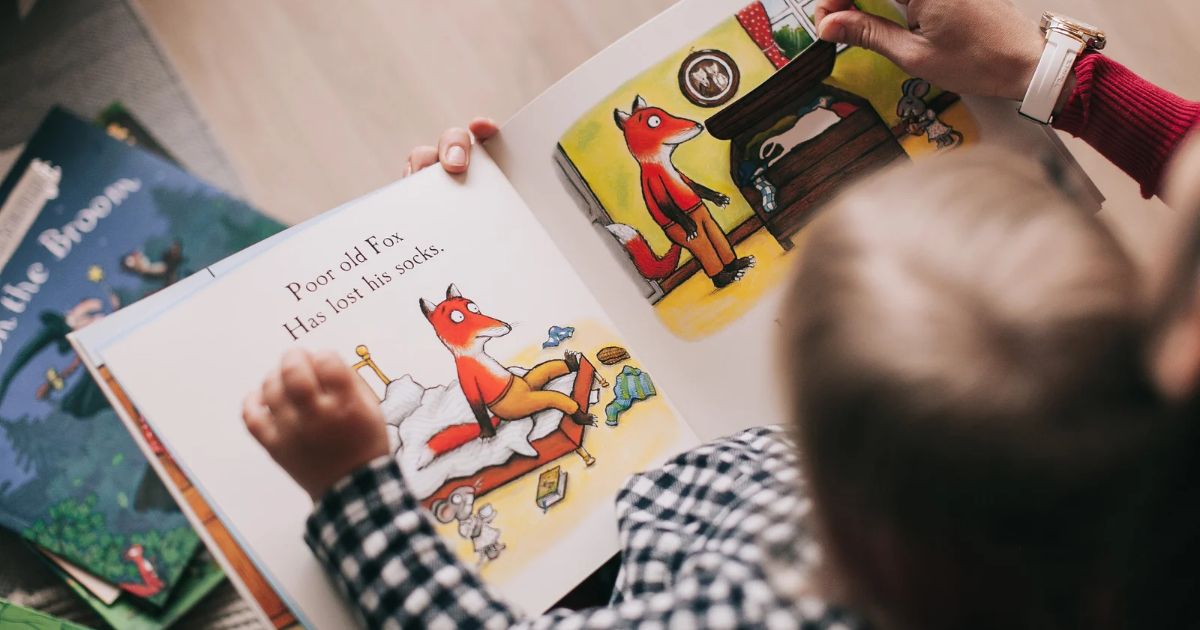
When we think of a children’s book, we usually think of its story. For a child, however, the story is one of the last things they discover. The journey of exploration begins with elements such as colours, illustrations, the weight of the book, the texture of its cover, and much more. A children’s book becomes a tangible experience for a child long before they are able to understand the text on its pages.
The First Encounter with Art
For many children, picture books represent one of their first encounters with art. Colour contrasts and page composition are not simply decorative elements, but rather a visual language that children learn to decode before they even learn to recognise words.
Researchers Evelyn Arizpe and Morag Styles studied how children respond to illustrations in books. They found that even children who struggle with written language can recognise different perspectives, moods and emotions through images.
This ability is known as visual literacy. Through illustrations, children learn to observe, interpret and discover meanings that go beyond written language.
An Experience That Engages the Senses
A child’s relationship with a book is not only visual, but also physical. The texture of the paper, the thickness of the pages and the way children explore and handle a book engage more than one of their senses.
This dimension has been explored by Natalia Kucirkova, Professor of Early Childhood Development at the University of Stavanger. Together with Lucy Rodriguez-Leon, she reviewed 35 studies examining the role of the senses in children’s reading experiences.
Their research focuses on two key concepts: embodied engagement, which refers to a child’s involvement through touch and handling the book, and materiality, which highlights the importance of its shape, weight and texture.
A book, therefore, tells a story not only through its words and illustrations, but also through the way a child touches it, explores it and ultimately experiences it.
Paper or Screen: Which Offers Greater Benefits for Children?
Two research studies provide valuable insights into how different reading formats affect children’s development.
A major meta-analysis by Furenes, Kucirkova and Bus (2021) combined findings from 39 previous studies, involving a total of 1,812 children aged between 1 and 8. The researchers compared children’s experiences of reading exactly the same story in print and on screen.
The findings showed that children ultimately understood less of the story when reading on a digital device. Furthermore, the active involvement of a parent during shared reading with a printed book proved more beneficial than the interactive effects and games featured in digital books.
A second study conducted at the University of Michigan (Munzer et al., 2019) examined how parents and children communicate while reading together. The study involved 37 parent-child pairs, with children aged 2 to 3. They read stories in three different formats: a traditional printed book, a basic electronic book (without interactive features) and an interactive electronic book (with sounds and animations).
The results revealed a significant difference. When reading printed books, parents and children engaged in much more conversation: they asked questions, discussed the storyline and connected it to their own experiences. Children participated more actively, while parent-child interaction and bonding were more evident through hugs, eye contact and shared moments.
In contrast, when using tablets, conversation decreased considerably as attention was diverted towards interacting with the screen. Even when using a basic digital format without any interactive features, communication was less engaging. The researchers concluded that the very nature of the screen seemed to come between parent and child, interrupting the natural flow of communication.
Much More Than Just a Story
A children’s book offers far more than the narration of a story. It nurtures visual literacy, creates a sensory connection with reading and provides a shared space for communication between children and parents.
It is, therefore, a child’s first encounter with art, an experience that engages the senses and, at the same time, an opportunity for human connection.
References
- Arizpe, E. & Styles, M. (2016). Children Reading Picturebooks: Interpreting Visual Texts (2nd ed.). Routledge.
- Kucirkova, N. & Rodriguez-Leon, L. (2023). Multisensory Reading in Early Childhood. Human Development, 67(4), 193–210.
- Veryeri Alaca, I. Introduction to the special issue “Materiality in Picturebooks”, pp. 243–255. (Full bibliographic details to be completed.)
- Furenes, M. I., Kucirkova, N. & Bus, A. G. (2021). A Comparison of Children’s Reading on Paper Versus Screen: A Meta-Analysis. Review of Educational Research, 91(4), 483–517.
- Munzer, T. G. et al. (2019). Differences in Parent-Toddler Interactions With Electronic Versus Print Books. Pediatrics, 143(4), e20182012.